|
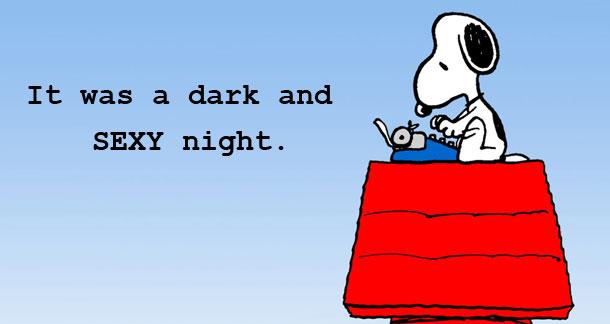
| Source: LitReactor |
In actual word count, if the literary novels in my bookcase accurately represent human experience, it looks as if people spend roughly half their time in intelligent dialogue about the meaning of their lives, and 1 percent of it practicing or contemplating coition.
Excuse me, but I don’t think so.
Why should literary authors shy away from something so important? Nobody else does. If we calibrated human experience on the basis of television, magazine covers and billboards, we would have to conclude that humans devote more time to copulation than to sleeping, eating and accessorizing the hot new summer look, combined. (Possibly even more than shooting one another with firearms, though that’s a tough call.) Filmmakers don’t risk being taken less seriously for including sexual content; in fact, they may risk it if they don’t.
But serious literature seems to be looking the other way, ready to take on anything else, with impunity. Myself, I’ve written about every awful thing from the death of a child to the morality of political assassination, and I’ve never felt fainthearted before. What is it about describing acts of love that makes me go pale? There is, of course, the claim that women who make a public show of being acquainted with sexuality are expressing deviance, but that’s also said about women who make a show of knowing anything, and I can’t imagine being daunted by such nonsense.
For decent folk of any gender, the official and legal position of our culture is that sex takes place in private, and that’s surely part of the problem. Private things—newfound love, family disagreements and spiritual faith, to name a few—can quickly become banal or irritating when moved into the public arena. But new love, family squabbles and spirituality are rich ground for literature when they’re handled with care. Writers don’t avoid them on grounds of privacy, but rather take it as duty to draw insights from personal things and render them universal. Nothing could be more secret, after all, than the inside of another person’s mind, and that is just where a novel takes us, usually from Page 1. No subject is too private for good fiction if it can be made beautiful and enlightening.
That may be the rub right there. Making it beautiful is no small trick. The language of coition has been stolen, or rather, I think, it has been divvied up like chips in a poker game among pornography, consumerism and the medical profession. None of these players are concerned with aesthetics, so the linguistic chips have become unpretty by association. “Vagina” is fatally paired with “speculum.” Any word you can name for the male sex organ or its, um, movement seems to be the property of Larry Flynt. Even a perfectly serviceable word like “nut,” when uttered by an adult, causes paroxysms in sixth-grade boys.
My word processing program’s thesaurus has washed its hands of the matter: it eschews any word remotely associated with making love. “Coitus,” for example, claims to be NOT FOUND, and the program coyly suggests as the nearest alternative “coincide with?” It also pleads ignorant on “penis” and suggests “pen friend.” A writer in work-avoidance mode could amuse herself all day.
I realize linguistic aesthetics may not be Microsoft’s concern here; more likely it’s mothers. Roget’s does much better, reinforcing my conviction that the book is mightier (or at least braver) than the computer. My St. Martin’s Roget’s Thesaurus obligingly offers up 15 synonyms for coition—though some are dubious, like “couplement”—and an impressive 28 descriptors for genitalia, though again some of these are obscure. In a scene where lingam meets yoni, I’m not even sure who I’m rooting for.
Nevertheless, the language is ours for the taking. Fiction writers have found elegant ways to describe life on other planets, or in a rabbit warren, or an elephant tribe, inventing the language they needed to navigate passages previously uncharted by our tongue. We don’t normally call off the game on account of linguistic handicaps. When it comes to the couplement of yoni, I think the real handicap is a cultural one.
We live in a strange land where marketers can display teenage models in the receptive lordotic posture (look it up) to sell jeans or liquor, but the basics of human procreation can’t be discussed in a middle-school science class without sparking parental ire. The same is true for evolution, incidentally, and I think the reason is the same: our tradition is to deny, for all we’re worth, that we’re in any way connected with the rest of life on earth. We don’t come from it, we’re not part of it, we own it.
It is deeply threatening to our ideology, at the corporate and theological levels, to admit we’re constrained by the laws of biology. Sex is the ultimate animal necessity. We can’t get rid of it. The harder we try to deny it official status, the more it asserts itself in banal, embarrassing ways. And so here we are, modern Americans with our heads soaked in frank sexual imagery and our feet planted in our Puritanical heritage, and any novelist with something to say about procreation or the lordotic posture has to nnegotiate that territory. Great sex is more rare in art than in life because it’s harder to do.
~ Barbara Kingsolver
Excuse me, but I don’t think so.
Why should literary authors shy away from something so important? Nobody else does. If we calibrated human experience on the basis of television, magazine covers and billboards, we would have to conclude that humans devote more time to copulation than to sleeping, eating and accessorizing the hot new summer look, combined. (Possibly even more than shooting one another with firearms, though that’s a tough call.) Filmmakers don’t risk being taken less seriously for including sexual content; in fact, they may risk it if they don’t.
But serious literature seems to be looking the other way, ready to take on anything else, with impunity. Myself, I’ve written about every awful thing from the death of a child to the morality of political assassination, and I’ve never felt fainthearted before. What is it about describing acts of love that makes me go pale? There is, of course, the claim that women who make a public show of being acquainted with sexuality are expressing deviance, but that’s also said about women who make a show of knowing anything, and I can’t imagine being daunted by such nonsense.
For decent folk of any gender, the official and legal position of our culture is that sex takes place in private, and that’s surely part of the problem. Private things—newfound love, family disagreements and spiritual faith, to name a few—can quickly become banal or irritating when moved into the public arena. But new love, family squabbles and spirituality are rich ground for literature when they’re handled with care. Writers don’t avoid them on grounds of privacy, but rather take it as duty to draw insights from personal things and render them universal. Nothing could be more secret, after all, than the inside of another person’s mind, and that is just where a novel takes us, usually from Page 1. No subject is too private for good fiction if it can be made beautiful and enlightening.
That may be the rub right there. Making it beautiful is no small trick. The language of coition has been stolen, or rather, I think, it has been divvied up like chips in a poker game among pornography, consumerism and the medical profession. None of these players are concerned with aesthetics, so the linguistic chips have become unpretty by association. “Vagina” is fatally paired with “speculum.” Any word you can name for the male sex organ or its, um, movement seems to be the property of Larry Flynt. Even a perfectly serviceable word like “nut,” when uttered by an adult, causes paroxysms in sixth-grade boys.
My word processing program’s thesaurus has washed its hands of the matter: it eschews any word remotely associated with making love. “Coitus,” for example, claims to be NOT FOUND, and the program coyly suggests as the nearest alternative “coincide with?” It also pleads ignorant on “penis” and suggests “pen friend.” A writer in work-avoidance mode could amuse herself all day.
I realize linguistic aesthetics may not be Microsoft’s concern here; more likely it’s mothers. Roget’s does much better, reinforcing my conviction that the book is mightier (or at least braver) than the computer. My St. Martin’s Roget’s Thesaurus obligingly offers up 15 synonyms for coition—though some are dubious, like “couplement”—and an impressive 28 descriptors for genitalia, though again some of these are obscure. In a scene where lingam meets yoni, I’m not even sure who I’m rooting for.
Nevertheless, the language is ours for the taking. Fiction writers have found elegant ways to describe life on other planets, or in a rabbit warren, or an elephant tribe, inventing the language they needed to navigate passages previously uncharted by our tongue. We don’t normally call off the game on account of linguistic handicaps. When it comes to the couplement of yoni, I think the real handicap is a cultural one.
We live in a strange land where marketers can display teenage models in the receptive lordotic posture (look it up) to sell jeans or liquor, but the basics of human procreation can’t be discussed in a middle-school science class without sparking parental ire. The same is true for evolution, incidentally, and I think the reason is the same: our tradition is to deny, for all we’re worth, that we’re in any way connected with the rest of life on earth. We don’t come from it, we’re not part of it, we own it.
It is deeply threatening to our ideology, at the corporate and theological levels, to admit we’re constrained by the laws of biology. Sex is the ultimate animal necessity. We can’t get rid of it. The harder we try to deny it official status, the more it asserts itself in banal, embarrassing ways. And so here we are, modern Americans with our heads soaked in frank sexual imagery and our feet planted in our Puritanical heritage, and any novelist with something to say about procreation or the lordotic posture has to nnegotiate that territory. Great sex is more rare in art than in life because it’s harder to do.
~ Barbara Kingsolver