Showing posts with label Writer. Show all posts

Sunday

Writing

Image by mohamed Hassan from Pixabay 
Ever since I was a little kid, I’ve thought that there was something noble and mysterious about writing, about the people who could do it well, who could create a world as if they were little gods or sorcerers. All my life I’ve felt that there was something magical about people who could get into other people’s minds and skin, who could take people like me out of ourselves and then take us back to ourselves. And you know what? I still do.

~ Anne Lamott


Thank you!

Source: Favim
Thank you for the writing, for taking the time and spirit and soul to write, because I love to read, and I'm so thankful to writers like you, for writing things for me to read. And keep going, even when people make you feel like it's not that important. It might be the most important thing you do. Keep going. 
So to all the secret writers, late-night painters, would-be singers, lapsed and scared artists of every stripe, dig out your paintbrush, or your flute, or your dancing shoes. Pull out your camera or your computer or your pottery wheel. Today, tonight, after the kids are in bed or when your homework is done, or instead of one more video game or magazine, create something, anything.
Pick up a needle and thread, and stitch together something particular and honest and beautiful, because we need it. I need it.
Thank you, and keep going.

~ Shauna Niequist

Thank you!

Source: Favim
Thank you for the writing, for taking the time and spirit and soul to write, because I love to read, and I'm so thankful to writers like you, for writing things for me to read. And keep going, even when people make you feel like it's not that important. It might be the most important thing you do. Keep going. 
So to all the secret writers, late-night painters, would-be singers, lapsed and scared artists of every stripe, dig out your paintbrush, or your flute, or your dancing shoes. Pull out your camera or your computer or your pottery wheel. Today, tonight, after the kids are in bed or when your homework is done, or instead of one more video game or magazine, create something, anything.
Pick up a needle and thread, and stitch together something particular and honest and beautiful, because we need it. I need it.
Thank you, and keep going.

~ Shauna Niequist

Friday

In case you missed AWP 2014: Fifteen Ways of Looking at a Conference

Source: German British Forum
I

I went running beforehand, just at dawn,
heard a varied thrush, down from the mountains.
And I could’ve gone home happy then.

II

I wore my most fabulous garment, a coat,
even when I was indoors. Because every writer
needs a security blanket. And every other writer
needs a companion dog. But I get that.
It is hard to be with twelve thousand people
who all want the two tablespoons of fame
available in our measly genre. Very hard.

III

I have never heard of anybody. Or met anybody. Or read anybody.
I have never done anything with trochees.
Is it too late? I write down quotes.

IV

If you’re an editor, use a green pencil.
A poet must be a good reporter, but he must be something more.
Poetry can add to the stock of available reality.
Want to write better? Be more.
If it doesn’t sound right it’s no fucking good.
Bears aren’t afraid of being asleep.
The more you try to be original, the less original you’ll be.

V

You’re welcome.
I just saved you
$230 and that’s
if you signed up before Halloween.

VI

Know how when you leave an art museum
everything looks like art, even stop signs?
Everything sounds like poetry by around 2 p.m.

VII

I hate being all fan-ny, but there is no alternative.
There is the famous poet who wrote me a blurb.
I say thank you, even though I did so at the last gathering.
And then what to say? Umm. Thanks again?

VIII

I am talking to a younger writer
and come up with a quote:
You can’t not write.
I never wanted a tattoo before this.

IX

That awkward moment at the cocktail party when
your friend introduces you to someone and says
“Hey, Ben’s a poet. Ben, this is Tina. Tina’s a poet.”
Kind introducer is pleased somehow. She forgets:
Poets have nothing to say to poets. Not always,
but mostly.

X

You are my tribe. But we do not dress the same.
I forgot to get a piercing for this. And dye my hair neon.
And wear a long gingham prairie dress. Or painted shoes.
The black coat serves me well.

XI

The things you hear.
“We are rebuilding
the emotional infrastructure
of the world.”
Sigh.

XIII

We share ego insecurity desire for immortality rejections very long scarves
comfort that fame can come posthumously knowledge that we usually feel better
after we write a curious fascination with the truth of long lists disdain for commas

XIV

We develop prowess in submission.
We apply to a retreat,
something you do after you lose.

XV

We observe each other up and down
the convention center’s cascading escalators,
six floors of them! And smile and wonder
and star in our own author interviews
in our minds, and hope for the best.

~ Tina Kelley

In case you missed AWP 2014: Fifteen Ways of Looking at a Conference

Source: German British Forum
I

I went running beforehand, just at dawn,
heard a varied thrush, down from the mountains.
And I could’ve gone home happy then.

II

I wore my most fabulous garment, a coat,
even when I was indoors. Because every writer
needs a security blanket. And every other writer
needs a companion dog. But I get that.
It is hard to be with twelve thousand people
who all want the two tablespoons of fame
available in our measly genre. Very hard.

III

I have never heard of anybody. Or met anybody. Or read anybody.
I have never done anything with trochees.
Is it too late? I write down quotes.

IV

If you’re an editor, use a green pencil.
A poet must be a good reporter, but he must be something more.
Poetry can add to the stock of available reality.
Want to write better? Be more.
If it doesn’t sound right it’s no fucking good.
Bears aren’t afraid of being asleep.
The more you try to be original, the less original you’ll be.

V

You’re welcome.
I just saved you
$230 and that’s
if you signed up before Halloween.

VI

Know how when you leave an art museum
everything looks like art, even stop signs?
Everything sounds like poetry by around 2 p.m.

VII

I hate being all fan-ny, but there is no alternative.
There is the famous poet who wrote me a blurb.
I say thank you, even though I did so at the last gathering.
And then what to say? Umm. Thanks again?

VIII

I am talking to a younger writer
and come up with a quote:
You can’t not write.
I never wanted a tattoo before this.

IX

That awkward moment at the cocktail party when
your friend introduces you to someone and says
“Hey, Ben’s a poet. Ben, this is Tina. Tina’s a poet.”
Kind introducer is pleased somehow. She forgets:
Poets have nothing to say to poets. Not always,
but mostly.

X

You are my tribe. But we do not dress the same.
I forgot to get a piercing for this. And dye my hair neon.
And wear a long gingham prairie dress. Or painted shoes.
The black coat serves me well.

XI

The things you hear.
“We are rebuilding
the emotional infrastructure
of the world.”
Sigh.

XIII

We share ego insecurity desire for immortality rejections very long scarves
comfort that fame can come posthumously knowledge that we usually feel better
after we write a curious fascination with the truth of long lists disdain for commas

XIV

We develop prowess in submission.
We apply to a retreat,
something you do after you lose.

XV

We observe each other up and down
the convention center’s cascading escalators,
six floors of them! And smile and wonder
and star in our own author interviews
in our minds, and hope for the best.

~ Tina Kelley

Tuesday

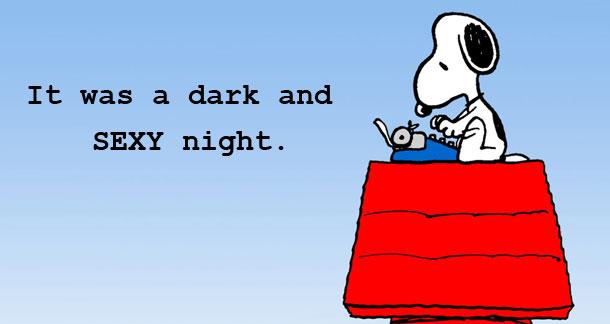
Quote: Writing about sex

Source: LitReactor
In actual word count, if the literary novels in my bookcase accurately represent human experience, it looks as if people spend roughly half their time in intelligent dialogue about the meaning of their lives, and 1 percent of it practicing or contemplating coition.
Excuse me, but I don’t think so.
Why should literary authors shy away from something so important? Nobody else does. If we calibrated human experience on the basis of television, magazine covers and billboards, we would have to conclude that humans devote more time to copulation than to sleeping, eating and accessorizing the hot new summer look, combined. (Possibly even more than shooting one another with firearms, though that’s a tough call.) Filmmakers don’t risk being taken less seriously for including sexual content; in fact, they may risk it if they don’t.
But serious literature seems to be looking the other way, ready to take on anything else, with impunity. Myself, I’ve written about every awful thing from the death of a child to the morality of political assassination, and I’ve never felt fainthearted before. What is it about describing acts of love that makes me go pale? There is, of course, the claim that women who make a public show of being acquainted with sexuality are expressing deviance, but that’s also said about women who make a show of knowing anything, and I can’t imagine being daunted by such nonsense.
For decent folk of any gender, the official and legal position of our culture is that sex takes place in private, and that’s surely part of the problem. Private things—newfound love, family disagreements and spiritual faith, to name a few—can quickly become banal or irritating when moved into the public arena. But new love, family squabbles and spirituality are rich ground for literature when they’re handled with care. Writers don’t avoid them on grounds of privacy, but rather take it as duty to draw insights from personal things and render them universal. Nothing could be more secret, after all, than the inside of another person’s mind, and that is just where a novel takes us, usually from Page 1. No subject is too private for good fiction if it can be made beautiful and enlightening.
That may be the rub right there. Making it beautiful is no small trick. The language of coition has been stolen, or rather, I think, it has been divvied up like chips in a poker game among pornography, consumerism and the medical profession. None of these players are concerned with aesthetics, so the linguistic chips have become unpretty by association. “Vagina” is fatally paired with “speculum.” Any word you can name for the male sex organ or its, um, movement seems to be the property of Larry Flynt. Even a perfectly serviceable word like “nut,” when uttered by an adult, causes paroxysms in sixth-grade boys.
My word processing program’s thesaurus has washed its hands of the matter: it eschews any word remotely associated with making love. “Coitus,” for example, claims to be NOT FOUND, and the program coyly suggests as the nearest alternative “coincide with?” It also pleads ignorant on “penis” and suggests “pen friend.” A writer in work-avoidance mode could amuse herself all day.
I realize linguistic aesthetics may not be Microsoft’s concern here; more likely it’s mothers. Roget’s does much better, reinforcing my conviction that the book is mightier (or at least braver) than the computer. My St. Martin’s Roget’s Thesaurus obligingly offers up 15 synonyms for coition—though some are dubious, like “couplement”—and an impressive 28 descriptors for genitalia, though again some of these are obscure. In a scene where lingam meets yoni, I’m not even sure who I’m rooting for.
Nevertheless, the language is ours for the taking. Fiction writers have found elegant ways to describe life on other planets, or in a rabbit warren, or an elephant tribe, inventing the language they needed to navigate passages previously uncharted by our tongue. We don’t normally call off the game on account of linguistic handicaps. When it comes to the couplement of yoni, I think the real handicap is a cultural one.
We live in a strange land where marketers can display teenage models in the receptive lordotic posture (look it up) to sell jeans or liquor, but the basics of human procreation can’t be discussed in a middle-school science class without sparking parental ire. The same is true for evolution, incidentally, and I think the reason is the same: our tradition is to deny, for all we’re worth, that we’re in any way connected with the rest of life on earth. We don’t come from it, we’re not part of it, we own it.
It is deeply threatening to our ideology, at the corporate and theological levels, to admit we’re constrained by the laws of biology. Sex is the ultimate animal necessity. We can’t get rid of it. The harder we try to deny it official status, the more it asserts itself in banal, embarrassing ways. And so here we are, modern Americans with our heads soaked in frank sexual imagery and our feet planted in our Puritanical heritage, and any novelist with something to say about procreation or the lordotic posture has to nnegotiate that territory. Great sex is more rare in art than in life because it’s harder to do.

~ Barbara Kingsolver

Quote: Writing about sex

Source: LitReactor
In actual word count, if the literary novels in my bookcase accurately represent human experience, it looks as if people spend roughly half their time in intelligent dialogue about the meaning of their lives, and 1 percent of it practicing or contemplating coition.
Excuse me, but I don’t think so.
Why should literary authors shy away from something so important? Nobody else does. If we calibrated human experience on the basis of television, magazine covers and billboards, we would have to conclude that humans devote more time to copulation than to sleeping, eating and accessorizing the hot new summer look, combined. (Possibly even more than shooting one another with firearms, though that’s a tough call.) Filmmakers don’t risk being taken less seriously for including sexual content; in fact, they may risk it if they don’t.
But serious literature seems to be looking the other way, ready to take on anything else, with impunity. Myself, I’ve written about every awful thing from the death of a child to the morality of political assassination, and I’ve never felt fainthearted before. What is it about describing acts of love that makes me go pale? There is, of course, the claim that women who make a public show of being acquainted with sexuality are expressing deviance, but that’s also said about women who make a show of knowing anything, and I can’t imagine being daunted by such nonsense.
For decent folk of any gender, the official and legal position of our culture is that sex takes place in private, and that’s surely part of the problem. Private things—newfound love, family disagreements and spiritual faith, to name a few—can quickly become banal or irritating when moved into the public arena. But new love, family squabbles and spirituality are rich ground for literature when they’re handled with care. Writers don’t avoid them on grounds of privacy, but rather take it as duty to draw insights from personal things and render them universal. Nothing could be more secret, after all, than the inside of another person’s mind, and that is just where a novel takes us, usually from Page 1. No subject is too private for good fiction if it can be made beautiful and enlightening.
That may be the rub right there. Making it beautiful is no small trick. The language of coition has been stolen, or rather, I think, it has been divvied up like chips in a poker game among pornography, consumerism and the medical profession. None of these players are concerned with aesthetics, so the linguistic chips have become unpretty by association. “Vagina” is fatally paired with “speculum.” Any word you can name for the male sex organ or its, um, movement seems to be the property of Larry Flynt. Even a perfectly serviceable word like “nut,” when uttered by an adult, causes paroxysms in sixth-grade boys.
My word processing program’s thesaurus has washed its hands of the matter: it eschews any word remotely associated with making love. “Coitus,” for example, claims to be NOT FOUND, and the program coyly suggests as the nearest alternative “coincide with?” It also pleads ignorant on “penis” and suggests “pen friend.” A writer in work-avoidance mode could amuse herself all day.
I realize linguistic aesthetics may not be Microsoft’s concern here; more likely it’s mothers. Roget’s does much better, reinforcing my conviction that the book is mightier (or at least braver) than the computer. My St. Martin’s Roget’s Thesaurus obligingly offers up 15 synonyms for coition—though some are dubious, like “couplement”—and an impressive 28 descriptors for genitalia, though again some of these are obscure. In a scene where lingam meets yoni, I’m not even sure who I’m rooting for.
Nevertheless, the language is ours for the taking. Fiction writers have found elegant ways to describe life on other planets, or in a rabbit warren, or an elephant tribe, inventing the language they needed to navigate passages previously uncharted by our tongue. We don’t normally call off the game on account of linguistic handicaps. When it comes to the couplement of yoni, I think the real handicap is a cultural one.
We live in a strange land where marketers can display teenage models in the receptive lordotic posture (look it up) to sell jeans or liquor, but the basics of human procreation can’t be discussed in a middle-school science class without sparking parental ire. The same is true for evolution, incidentally, and I think the reason is the same: our tradition is to deny, for all we’re worth, that we’re in any way connected with the rest of life on earth. We don’t come from it, we’re not part of it, we own it.
It is deeply threatening to our ideology, at the corporate and theological levels, to admit we’re constrained by the laws of biology. Sex is the ultimate animal necessity. We can’t get rid of it. The harder we try to deny it official status, the more it asserts itself in banal, embarrassing ways. And so here we are, modern Americans with our heads soaked in frank sexual imagery and our feet planted in our Puritanical heritage, and any novelist with something to say about procreation or the lordotic posture has to nnegotiate that territory. Great sex is more rare in art than in life because it’s harder to do.

~ Barbara Kingsolver

Saturday

Paradox

Credit: Mariano Akerman
Paradox is beloved of novelists. The despised savior, the humane whore, the selfish man suddenly munificent, the wise fool, and the cowardly hero. Most writers spend their lives writing about unexpected malice in the supposedly virtuous, and unexpected virtue in the supposedly sinful.

~ Thomas Keneally


Paradox

Credit: Mariano Akerman
Paradox is beloved of novelists. The despised savior, the humane whore, the selfish man suddenly munificent, the wise fool, and the cowardly hero. Most writers spend their lives writing about unexpected malice in the supposedly virtuous, and unexpected virtue in the supposedly sinful.

~ Thomas Keneally


Tuesday

Quote on Writing

Source: Unknown/Favim.com
I often ask people what is their definition of a "writer." They usually tell me: "Somebody who has published books or articles" or "A person who makes their living by writing."
I disagree. I think somebody who writes everyday and looks at the workaday world through the prism of literature and words is a writer. Period.
If a person everyday honestly strives to get at the heart of a matter and glean the truth out of the complexity of this world and we human beings through the written word, than that person is a writer, in my opinion. It is a matter of attitude and a way of life, not how you pay your bills or whether you have talent or not.
To sum it all up, if you want to write, if you want to create, you must be the most sublime fool that God ever turned out and sent rambling.
You must write every single day of your life.
You must read dreadful dumb books and glorious books, and let them wrestle in beautiful fights inside your head, vulgar one moment, brilliant the next.
You must lurk in libraries and climb the stacks like ladders to sniff books like perfumes and wear books like hats upon your crazy heads.
I wish for you a wrestling match with your Creative Muse that will last a lifetime.
I wish craziness and foolishness and madness upon you.
May you live with hysteria, and out of it make fine stories.
Which finally means, may you be in love every day for the next 20,000 days. And out of that love, remake a world.

~ Ray Bradbury

Quote on Writing

Source: Unknown/Favim.com
I often ask people what is their definition of a "writer." They usually tell me: "Somebody who has published books or articles" or "A person who makes their living by writing."
I disagree. I think somebody who writes everyday and looks at the workaday world through the prism of literature and words is a writer. Period.
If a person everyday honestly strives to get at the heart of a matter and glean the truth out of the complexity of this world and we human beings through the written word, than that person is a writer, in my opinion. It is a matter of attitude and a way of life, not how you pay your bills or whether you have talent or not.
To sum it all up, if you want to write, if you want to create, you must be the most sublime fool that God ever turned out and sent rambling.
You must write every single day of your life.
You must read dreadful dumb books and glorious books, and let them wrestle in beautiful fights inside your head, vulgar one moment, brilliant the next.
You must lurk in libraries and climb the stacks like ladders to sniff books like perfumes and wear books like hats upon your crazy heads.
I wish for you a wrestling match with your Creative Muse that will last a lifetime.
I wish craziness and foolishness and madness upon you.
May you live with hysteria, and out of it make fine stories.
Which finally means, may you be in love every day for the next 20,000 days. And out of that love, remake a world.

~ Ray Bradbury

Saturday

Quote on writing

Source: www.nastol.com.ua/favim.com
All writers are vain, selfish, and lazy, and at the very bottom of their motives there lies a mystery. Writing a book is a horrible, exhausting struggle, like a long bout of some painful illness.
One would never undertake such a thing if one were not driven on by some demon whom one can neither resist nor understand. For all one knows that demon is simply the same instinct that makes a baby squall for attention. And yet it is also true that one can write nothing readable unless one constantly struggles to efface one's own personality.
Good prose is like a windowpane. I cannot say with certainty which of my motives are the strongest, but I know which of them deserve to be followed. And looking back through my work, I see that it is invariably where I lacked a political purpose that I wrote lifeless books and was betrayed into purple passages, sentences without meaning, decorative adjectives and humbug generally.

~ George Orwell

Quote on writing

Source: www.nastol.com.ua/favim.com
All writers are vain, selfish, and lazy, and at the very bottom of their motives there lies a mystery. Writing a book is a horrible, exhausting struggle, like a long bout of some painful illness.
One would never undertake such a thing if one were not driven on by some demon whom one can neither resist nor understand. For all one knows that demon is simply the same instinct that makes a baby squall for attention. And yet it is also true that one can write nothing readable unless one constantly struggles to efface one's own personality.
Good prose is like a windowpane. I cannot say with certainty which of my motives are the strongest, but I know which of them deserve to be followed. And looking back through my work, I see that it is invariably where I lacked a political purpose that I wrote lifeless books and was betrayed into purple passages, sentences without meaning, decorative adjectives and humbug generally.

~ George Orwell

Thursday

For the Young Who Want To

Image: FreeDigitalPhotos.net
 Talent is what they say
you have after the novel
is published and favorably
reviewed. Beforehand what
you have is a tedious
delusion, a hobby like knitting.

Work is what you have done
after the play is produced
and the audience claps.
Before that friends keep asking
when you are planning to go
out and get a job.

Genius is what they know you
had after the third volume
of remarkable poems. Earlier
they accuse you of withdrawing,
ask why you don't have a baby,
call you a bum.

The reason people want M.F.A.s,
take workshops with fancy names
when all you can really
learn is a few techniques,
typing instructions and some-
body else's mannerisms

is that every artist lacks
a license to hang on the wall
like your optician, your vet
proving you may be a clumsy sadist
whose fillings fall into the stew
but you're certified a dentist.

The real writer is one
who really writes. Talent
is an invention like phlogiston
after the fact of fire.
Work is its own cure. You have to
like it better than being loved.

~ Marge Piercy

For the Young Who Want To

Image: FreeDigitalPhotos.net
 Talent is what they say
you have after the novel
is published and favorably
reviewed. Beforehand what
you have is a tedious
delusion, a hobby like knitting.

Work is what you have done
after the play is produced
and the audience claps.
Before that friends keep asking
when you are planning to go
out and get a job.

Genius is what they know you
had after the third volume
of remarkable poems. Earlier
they accuse you of withdrawing,
ask why you don't have a baby,
call you a bum.

The reason people want M.F.A.s,
take workshops with fancy names
when all you can really
learn is a few techniques,
typing instructions and some-
body else's mannerisms

is that every artist lacks
a license to hang on the wall
like your optician, your vet
proving you may be a clumsy sadist
whose fillings fall into the stew
but you're certified a dentist.

The real writer is one
who really writes. Talent
is an invention like phlogiston
after the fact of fire.
Work is its own cure. You have to
like it better than being loved.

~ Marge Piercy